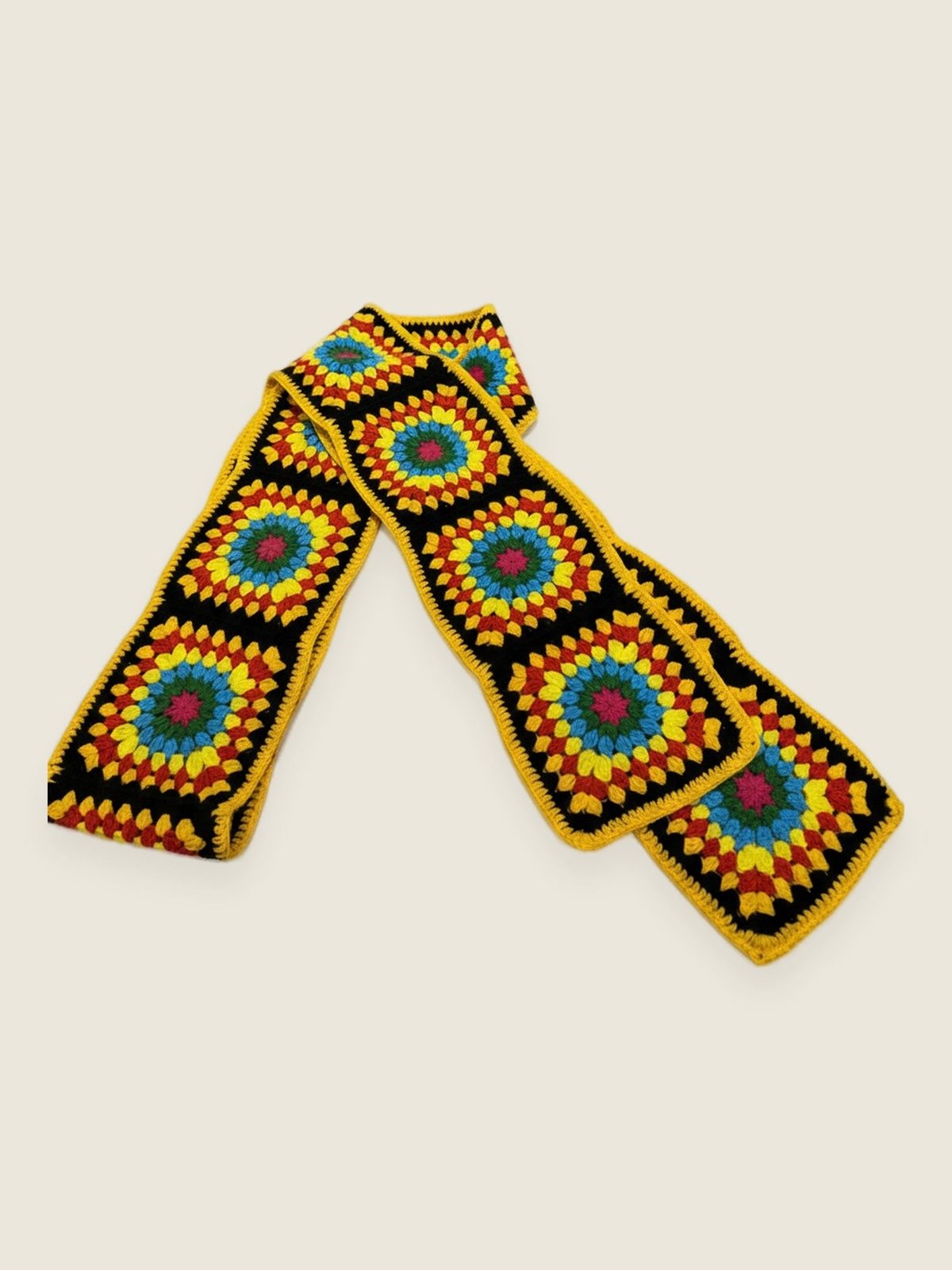
A colorful scarf is often the most expressive piece in an otherwise practical outfit. Against a neutral coat, it can bring in pattern, warmth, and personality without asking you to rebuild your wardrobe around it. The trick is not to make every color match. Give the scarf a clear place to land, keep the coat as a calm frame, and make a few deliberate choices about proportion and texture.
Neutral outerwear is not limited to beige. Black, charcoal, navy, olive, cream, and soft gray all work as a useful backdrop, though each changes the mood of a vivid scarf. Think of the coat as the quiet part of the outfit, not a blank rulebook. A good pairing should look intentional from a few steps away and still feel comfortable when the scarf is loosened indoors.
Start with the coat’s undertone and depth
Before choosing a tying method, notice whether your outerwear is light or dark and whether its neutral reads warm or cool. Camel, oatmeal, and warm brown tend to sit naturally beside saffron, rust, coral, and moss. Charcoal, navy, and cool gray make saturated blue, magenta, and crisp green look especially clear. These are useful starting points, not restrictions: a strong contrast can be the point.
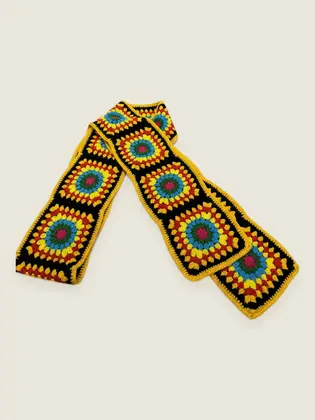
Consider the Saffron Scarf, whose description emphasizes bright gold, orange, red, and yellow around graphic motifs. With a camel or cream coat, its warm colors feel connected to the overall palette. With navy or black, those colors become more graphic and noticeable. Neither option is more correct; choose based on whether you want the scarf to blend into a warm outfit or provide a sharper focal point.
For a vivid scarf with several colors, find one small color relationship rather than matching the whole design. A dark coat can pick up a dark border or motif; a lighter coat can echo a pale accent. If your scarf contains no obvious color that appears in your coat, let the contrast stand. Matching a bag, shoes, hat, and gloves to every stripe can make a relaxed outfit feel overly coordinated.
Use scale to keep the outfit balanced
Color is only half the equation. A wide, textured scarf occupies more visual space than a narrow one, and a thick knot adds bulk around the face and neckline. If the scarf is bold in both color and pattern, give it room: leave the coat open when weather permits, choose a simple top beneath it, and avoid piling on another large print close to the face.
A long scarf can hang in two clean vertical lines over a coat. That creates an unbroken center and can make a relaxed layer look composed. If wind or warmth calls for wrapping it, try a single loop and let the ends fall at slightly different lengths. This keeps the scarf visible rather than burying its color in a bulky knot. For a shorter scarf, a soft loop at the collar can work well, provided it does not crowd a high neckline.
Texture deserves the same attention as volume. A smooth tailored coat paired with a visibly textured scarf creates contrast without requiring more pattern. If both pieces are substantial, keep the wrap loose and check the side view: the aim is to frame the face and coat lapels, not create a mound at the neck. Try the outfit with the coat closed and open; the best arrangement may change with the way the lapels sit.
Choose a tying approach for the coat you own
There is no single knot that suits every coat. A scarf can be arranged differently over a notched lapel, a high collar, or an oversized coat. Start with the simplest version, then adjust for warmth and movement.
With a lapel coat, drape the scarf around the back of your neck and let both ends fall down the front. The lapels frame the color, and the scarf stays easy to remove. For a little more security, cross the ends once without pulling them tight. This adds shape but leaves enough room to move your head comfortably.
A high-neck coat or a coat fastened to the top has less open space for a long drape. Fold the scarf in half, place the folded end around your neck, and pass the loose ends through the loop. Keep the loop relaxed rather than drawing it hard against your throat. If the scarf is especially substantial, a simple wrap with both ends tucked inside the coat may feel less crowded. Always adjust for ease of breathing and comfortable movement.
When the coat is oversized, resist making the scarf knot oversized too. A compact wrap keeps the silhouette from becoming all volume, while a more tailored coat can handle a softer, fuller drape. These small shifts make the combination feel considered without looking like you spent the morning engineering it.
Build a simple palette underneath
A colorful scarf does not require a monochrome outfit, but a restrained base makes getting dressed easier. Try denim with a cream knit, black trousers with a gray top, or olive pants with a white shirt. These familiar pieces create visual breathing room around an intricate scarf and let you repeat the combination in different ways.
If you want to wear another color, repeat one scarf shade in a modest detail rather than adding a second statement piece. A top in a related tone, for example, can connect to the scarf while the coat remains neutral. Keep the repetition subtle; a near match is often more relaxed than trying to find an exact shade. Pattern mixing can work, too, but scale matters: a small, quiet stripe underneath a large graphic scarf is usually easier to read than two equally busy designs.
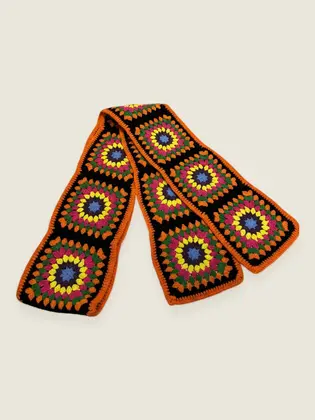
The Bonfire Scarf pairs dark squares and a bright orange edge with multiple vivid colors. A charcoal or black coat lets the design lead, while a gray sweater and uncomplicated jeans keep the outfit grounded. To bring in another layer of color, choose one shade already present in the scarf and use it once—perhaps in a top or a small accessory. The rest can stay neutral.
Let the occasion and weather guide the finish
For a weekday commute, comfort comes first: keep the knot secure enough for the walk, but loose enough to remove indoors without disturbing your hair or collar. For a casual lunch, an open drape can feel less bundled and show more of the scarf. On a windy day, tuck the ends inside the coat and check that nothing trails where it could catch. A polished look is not worth an awkward or unsafe arrangement.
Do a quick mirror check from the front and side. Is the scarf covering the coat’s useful details? Does its edge sit cleanly against the collar? Are the ends roughly balanced, unless an intentionally uneven drape looks better? Then move around: sit, turn your head, and lift your arms. A wrap that stays comfortable in motion will look more natural than one that only works in a still pose.
Care is part of making a favorite accessory last. Scarf fibers, construction, and embellishments vary, so do not assume that a generic washing method is safe. Read the item’s actual care label and follow the product-specific guidance; when the label is absent or unclear, ask the team before cleaning. Store the scarf in a way that avoids snagging against jewelry or coat hardware. For sizing and care details across the assortment, refer to Size and Care.
Make the combination feel like yours
A bright scarf works best with neutral outerwear when the outfit has one clear focal point and enough simplicity around it. Choose the coat for the mood you want, use a loose or secure wrap that suits its neckline, and repeat a color only if it feels natural. The same scarf can look warm with camel, graphic with navy, or quietly striking against gray.
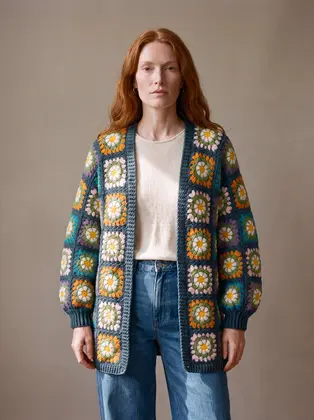
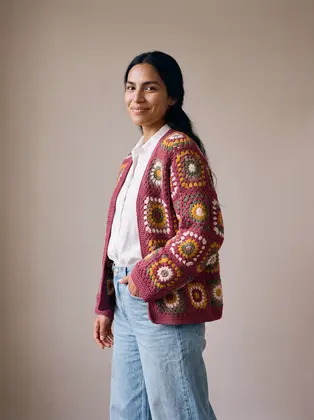
Explore the broader collection for pieces that can sit alongside your existing wardrobe, or browse cardigans for an easy layer beneath a coat. For a lighter base, the tops collection offers another route to a simple foundation. The point is not to create a perfectly matched set; it is to find a combination you will reach for on an ordinary morning, then wear it with the ease that makes personal style feel practical.